As of 22 June 2026, the men’s FIFA World Cup all-time scoring record is jointly held by Lionel Messi and Miroslav Klose on 16 goals, with Brazil’s Ronaldo on 15 and Kylian Mbappé already up to 14 during the current tournament. That headline matters, but it can also mislead: Klose and Messi reached 16 across 24 and 27 matches respectively, while Just Fontaine’s 13 came in only six games and Sándor Kocsis’s 11 in just five. In other words, the World Cup scoring race has always been part longevity contest, part peak-performance contest, and part tournament-format puzzle. The fairest way to read the leaderboard is to combine raw goals with context: number of editions played, matches available, penalties scored, knockout impact and the era’s structure.
A second crucial clarification: these are goals in the World Cup finals tournament only, not qualifying, not Olympic football, and not penalty-shootout conversions after a drawn match. Fans often blur those categories together. FIFA keeps qualifying records separately, and the Laws of the Game define shoot-outs as taking place after the match has ended. That distinction is why Fontaine still owns the single-edition record, why Messi’s pursuit of Klose is a live 2026 story, and why Marta’s 17 in the Women’s World Cup sits in a different but equally historic category.
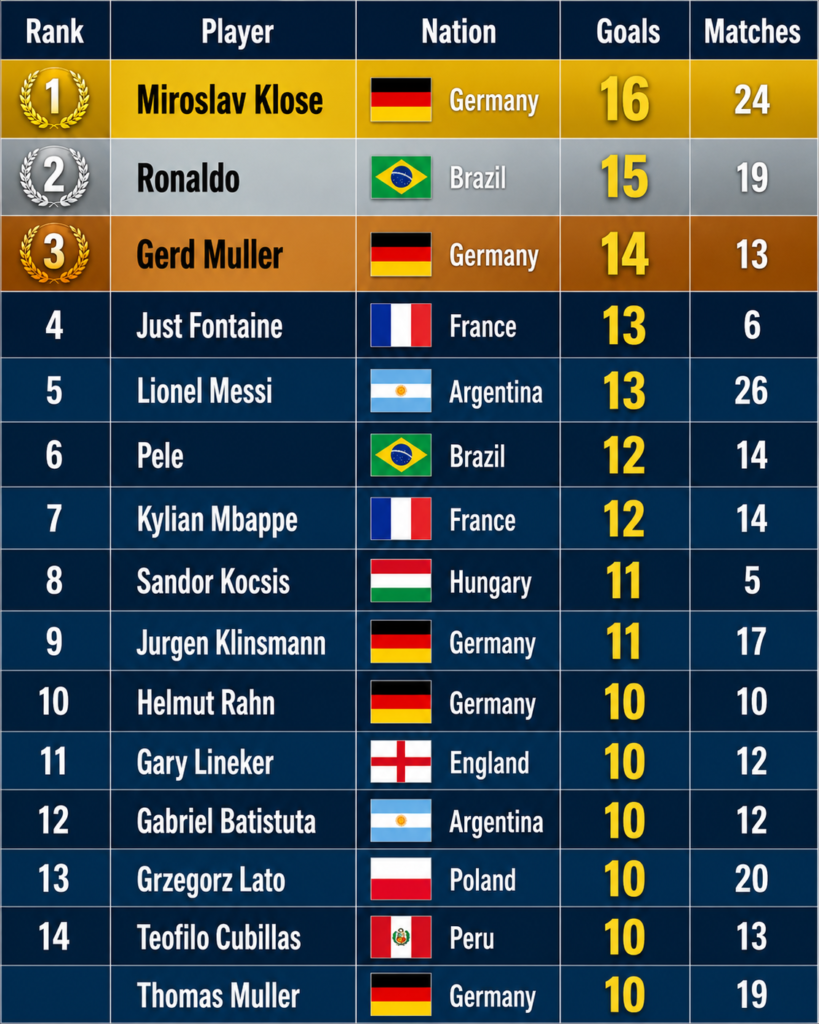
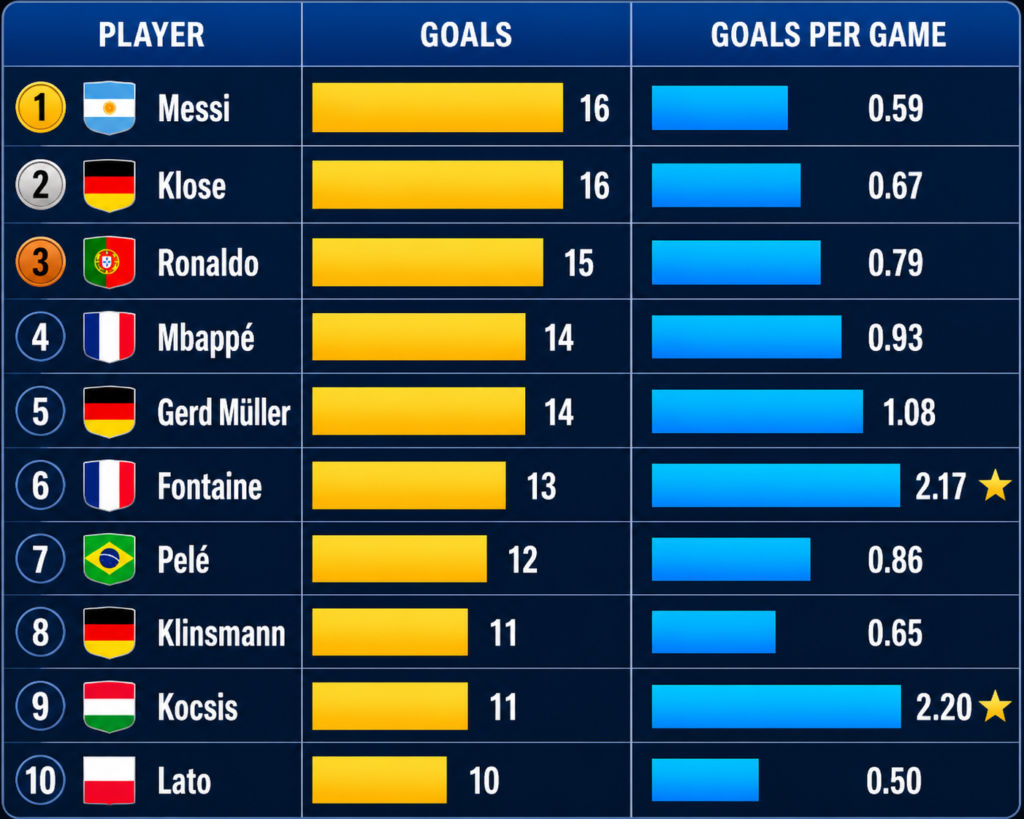
Current all-time table
The table below uses current World Cup goal and appearance totals from Transfermarkt’s all-time World Cup scorers page, cross-checked against FIFA’s all-time scorers pages and Reuters’ 2026 updates for Messi and Mbappé. Goals per game are calculated from those goal and appearance totals. Because FIFA treats equal goal totals as ties, the placement of players tied on the same number of goals is for table display only.
The legends behind the numbers
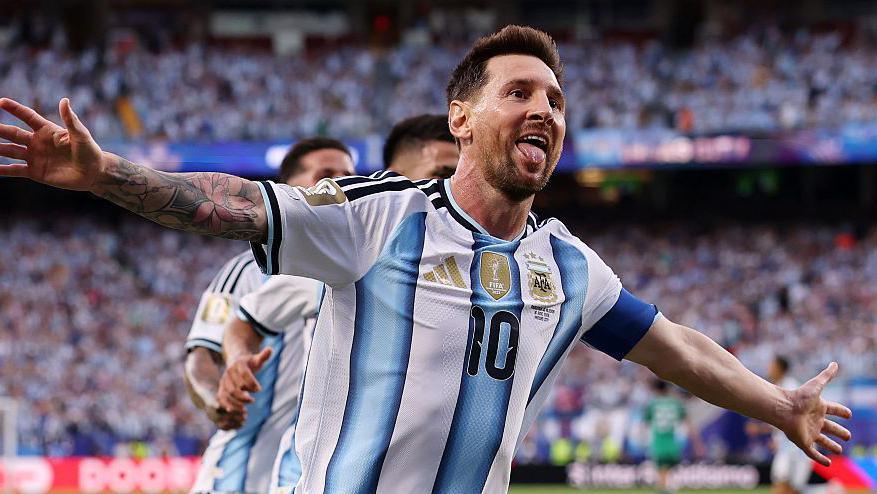
Messi has built perhaps the most layered World Cup scoring career of them all: 1 goal in 2006, 0 in 2010, 4 in 2014, 1 in 2018, 7 in 2022 and 3 already in 2026. His rise to 16 was driven not only by longevity but by genuinely decisive production: in Qatar 2022 he became the first man to score in the round of 16, quarter-final, semi-final and final of the same World Cup, and his 2026 hat-trick against Algeria — exactly 20 years after his first finals goal — pulled him level with Klose. Statbunker also shows that four of his World Cup goals have come from the penalty spot, which matters when comparing stylistic profiles across the leaderboard.
Klose, by contrast, is the archetype of tournament efficiency. FIFA’s official split is beautifully clean: 5 goals in 2002, 5 in 2006, 4 in 2010 and 2 in 2014. He announced himself with a 2002 hat-trick against Saudi Arabia, won the Golden Shoe on home soil in 2006, and then broke Ronaldo’s record with his 16th goal in the 7-1 semi-final demolition of Brazil in 2014. One reason modern analysts still love his case is that 16 goals in 24 matches is a stronger strike rate than Messi’s, and FIFA credits him with a record 17 World Cup wins as a player.
Ronaldo Nazário remains the bridge between old-school No 9 dominance and the modern global superstar. FIFA’s breakdown gives him 0 in 1994, 4 in 1998, 8 in 2002 and 3 in 2006. The key chapter was 2002: eight goals, two of them in the final against Germany, in one of the great redemption stories after the trauma of the 1998 final. Four years later, his goal against Ghana became his 15th and set the then outright record.
Mbappé is the great disruptor of the current era. His split is already extraordinary: 4 goals in 2018, 8 in 2022 and 2 in his opening 2026 match, giving him 14 goals in only 15 World Cup appearances. That includes the 2022 final hat-trick — the first in a men’s World Cup final since Geoff Hurst in 1966 — and two penalties in that match. Statbunker’s World Cup penalty table records two scored penalties for Mbappé overall, meaning most of his World Cup output has come from open play. At 27, he is the obvious favourite to finish as the outright all-time leader, especially now that the 48-team format can allow finalists to play eight matches instead of seven.
Gerd Müller and Just Fontaine are the purest reminders that peak scoring can be more frightening than cumulative scoring. Müller posted 10 goals in 1970 and 4 in 1974, then scored the winning goal in the 1974 final against the Netherlands. Fontaine did everything in one dazzling summer, scoring 13 in 1958 — still the single-edition record — with a hat-trick against Paraguay, a brace against Yugoslavia, the winner against Scotland, and four against Germany in the third-place match. If you are measuring “most devastating World Cup scorer at his absolute apex”, Fontaine has a very serious case.
Pelé sits in a category of his own because his goals are inseparable from titles and mythology. FIFA’s official split is 6 in 1958, 1 in 1962, 1 in 1966 and 4 in 1970. He remains the only player to win three men’s World Cups, the youngest winner, and — thanks to his 1958 semi-final and final exploits — the youngest finals goalscorer of true iconic status. His 1970 tournament, capped by a goal in the final against Italy, is the version of Pelé most fans imagine when they think of Brazil at its artistic peak.
The next tier is packed with cult heroes and era-defining finishers. Jürgen Klinsmann scored 3 goals in 1990, 5 in 1994 and 3 in 1998, becoming the first player to score more than twice at three different World Cups. Sándor Kocsis scored all 11 of his goals in 1954, including back-to-back hat-tricks and even a four-goal haul, which explains his staggering 2.20 goals-per-game ratio. Grzegorz Lato spread his 10 across three tournaments — 7 in 1974, 2 in 1978 and 1 in 1982 — and his 1974 Golden Boot helped carry Poland to third place.
Why era matters
Comparing these men across eras is irresistible, but it is never perfectly clean. FIFA’s own format history shows a tournament that has expanded repeatedly: 16-team World Cups dominated much of the pre-1982 period, the competition moved to 24 teams from 1982 to 1994, then to 32 teams from 1998 to 2022, and now to 48 teams with 104 matches in 2026. FIFA’s current 2026 format guide states that finalists can now play eight matches rather than the previous maximum of seven. That gives active stars more runway than earlier legends had, even before you account for sports science, substitutions, squad depth and longer elite careers.
That is why the goals-per-game lens is so useful. The raw-goal kings are Messi and Klose, but the ruthless per-match monsters are Kocsis, Fontaine and Gerd Müller. Put simply: Klose and Messi won the marathon, while Fontaine and Kocsis detonated the sprint. The 2026 expansion may further tilt the balance toward modern players, especially Mbappé, because more knockout rounds create more scoring opportunities without necessarily demanding a sixth tournament.
The records fans most often mix up
The most common confusion is between career finals goals and single-edition goals. Fontaine is not the all-time men’s World Cup scorer; he is the all-time leader for goals in one tournament, with 13 in 1958, a record that still stands. Likewise, Klose and Messi’s 16-goal mark refers only to the men’s finals tournament, not qualifiers. FIFA maintains a separate historical list for World Cup qualifying scorers.
The second confusion is between the men’s list and the combined senior World Cup conversation. FIFA states that Marta’s 17 goals at the Women’s World Cup remain unmatched by any player in either the women’s or men’s senior World Cups. So Messi and Klose are the men’s record-holders; Marta is the overall senior World Cup record-holder.
The third confusion is about penalties and shoot-outs. Penalties scored during normal time or extra time count exactly like any other goal; that is why Messi’s four World Cup penalty goals are fully legitimate in his total. Penalty-shootout kicks, however, are a different matter: under IFAB Law 10, they are taken after the match has ended, which is why official scorer tallies reflect goals scored during play, not shoot-out conversions. That is an inference from the Laws and from how FIFA’s World Cup records are kept.
Closing view
If you want the cleanest possible answer to “Who is the greatest World Cup scorer?”, there isn’t one. If you value totals, it is Messi and Klose — at least for the moment. If you value efficiency, Kocsis and Fontaine are terrifying outliers. If you value decisive, title-shaping goals, Pelé, Ronaldo and Gerd Müller become impossible to ignore. And if you value the future of the record itself, then this story increasingly looks like Mbappé’s. That is what makes the World Cup scoring chart so compelling: it is not just a list of goals, but a running argument about style, longevity, format and football history itself.
Recent coverage
The all-time scoring race is still moving during World Cup 2026, so any definitive ranking should be timestamped to the day it is published.